
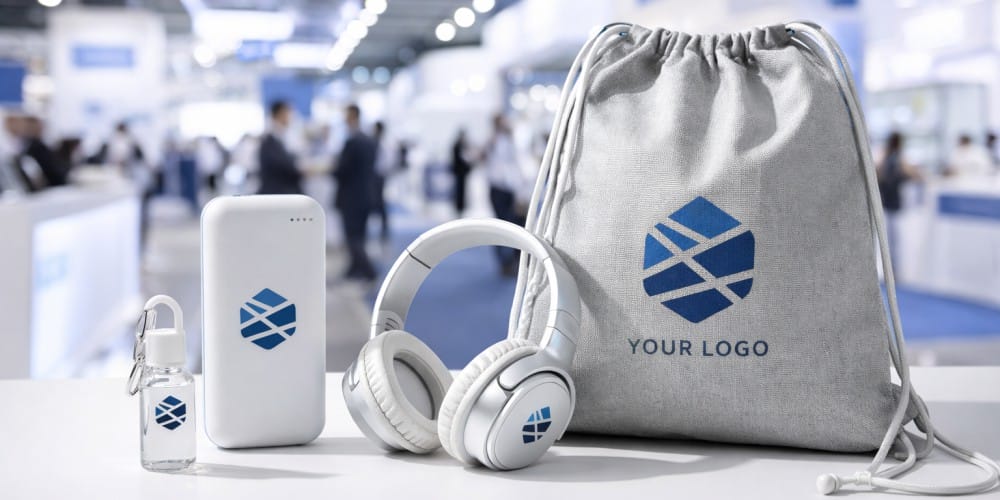
Trade show giveaways get judged on the wrong thing. The question is not which item people like most. It is which item does a job at your booth, at the moment you hand it over.
An attendee walking a hall passes dozens of tables. Some of them stop for two seconds and take whatever is nearest. A much smaller number stop, listen, and give you their contact details. Handing both groups the same item is where most giveaway budgets go wrong.
Two Giveaways, Not One
The strategy every experienced exhibitor converges on is a tiered one, and it is worth setting up before you order anything.
The first tier sits openly on the table. It is cheap, light, and anyone can take it. Its job is to slow people down as they pass and to give your staff a reason to say something.
The second tier stays behind the counter. It is noticeably better, and it is given only to people who have had a real conversation, taken a demo, or handed over a badge scan. Its job is to reward the interactions that are actually worth something.
Running one tier for both audiences means either giving good items to people who walked past, or giving cheap items to your best leads. Neither is what you want.
The Open Giveaway on the Table
This item needs to be light, cheap enough to give away freely, and useful within the next hour.
Swag stickers cost almost nothing, weigh nothing in a suitcase, and end up on laptops where they keep working for years. Pens get used at the show itself, which is more than most giveaways manage. Lanyards are unusual in that attendees genuinely need one for their badge, so a better lanyard than the event’s default gets worn all day by someone walking your brand around the hall.
Bags belong here too, with a caveat. A tote bag solves the problem every attendee has, which is carrying everything they have collected. Get them early in the day and yours is the bag everything else goes into.
The Gated Item You Trade for a Conversation
This is where the budget should concentrate, because these are the people you came for.
Insulated drinkware, quality apparel, or a small kit all work. What matters is that the item is visibly better than what is on the table, so the person understands they received something for engaging rather than for walking past.
Handing it over also gives your staff a natural close. Reaching behind the counter and saying that this one is for people who sat through the demo does more for the relationship than the object itself.
How Many Units Booth Traffic Actually Needs
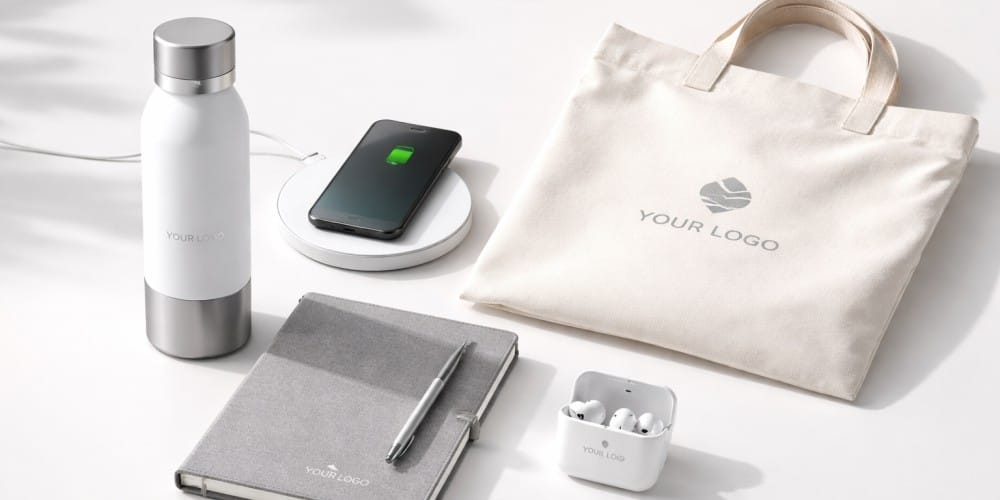
The maths is more predictable than it feels.
Start with the attendance figure the organiser publishes. Industry research consistently puts the share of total attendees who will stop at any given booth at roughly fifteen to twenty percent. On a two thousand person show, that is three to four hundred booth visits, not two thousand.
Of those visitors, the large majority are the quick-stop crowd. Order the open giveaway generously against that number, because running out on day one of a three day show is a worse outcome than a leftover box. For the gated item, order against the number of real conversations your staff can physically have, which is a much smaller figure than most people estimate.
Smaller shows invert the ratio. At a four hundred person event, attendees have time to visit almost every booth, so plan for a much higher share of them reaching you.
What Changes When You Fly to the Show
Weight and volume become the constraint, and this catches first-time exhibitors out.
Stickers, lanyards, and flat-packed bags travel well because they weigh little and compress. Drinkware, glass, and anything rigid does not, and a single case of tumblers can cost more in excess baggage than the tumblers cost.
Liquids are the other trap. Anything over the carry-on limit gets taken off you at security, so consumable giveaways involving liquid need to ship rather than fly.
The practical answer for anything heavy is shipping ahead to the venue or the show’s advance warehouse. Check the exhibitor manual for the deadline, because it is usually earlier than people expect and late shipments attract a surcharge.
Give It Early or Give It Late
Timing within the conversation matters more than the item.
Handing something over immediately is an icebreaker. It occupies the person’s hands, removes the awkwardness of approaching a stranger, and buys you the first thirty seconds.
Holding it back until the end makes it a thank you, and it keeps the person in the conversation while they wait for it. Both work. What does not work is a table people can raid without ever speaking to anyone, because then you have paid for merchandise and received nothing in exchange.
Giveaways That Work Against You
Some items actively cost you.
Food creates allergy and dietary problems you cannot manage from behind a table. Bulky items get politely declined because nobody wants to carry them for six more hours. Anything requiring assembly or an app will get neither. Novelty items get photographed and then left on a chair.
Branded items of poor quality are the worst case, because the person keeps it just long enough to form an opinion about your company, and the opinion is not the one you wanted.
Matching the Giveaway to Who Attends
Read the attendee list before choosing anything.
A trade audience that arrived by van has no carrying constraint and will take something substantial. A conference crowd flying home with hand luggage will not. Senior buyers respond to fewer, better items. A consumer show rewards volume and visibility.
Industry matters too. A hospitality audience notices quality of materials because that is their trade. A tech audience is oversupplied with cheap gadgets and undersupplied with anything genuinely well made.
Where Giveaways Fit With Booth Branding
Giveaways get people to your table. They do not get people across the hall to it, which is the job of the structure behind you.
The two need to look like they came from the same company. Matching colours and treatment between your trade show displays and the item in someone’s hand is what makes the brand register instead of blur. Our trade show essentials collection groups both sides together, and there is a separate guide on what to print for a trade show booth.