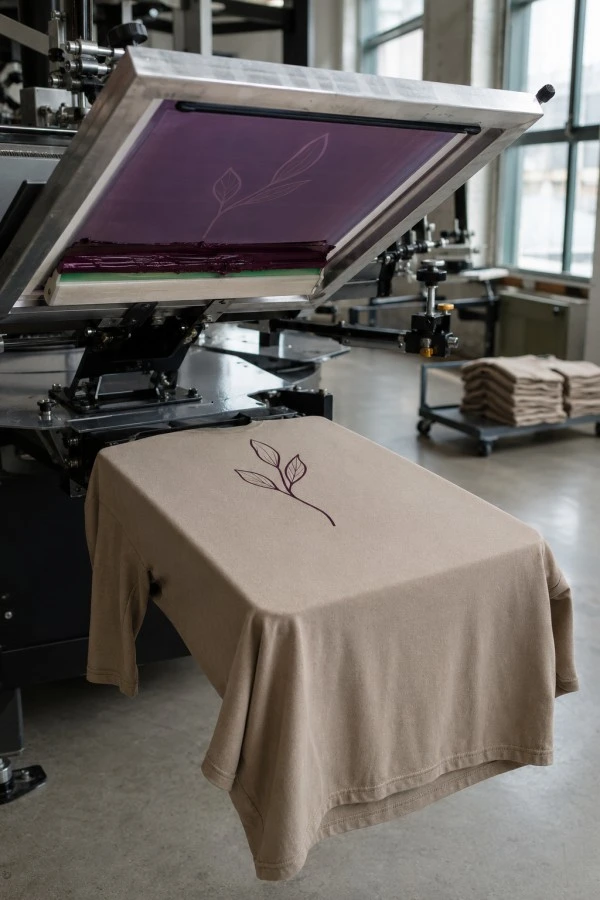
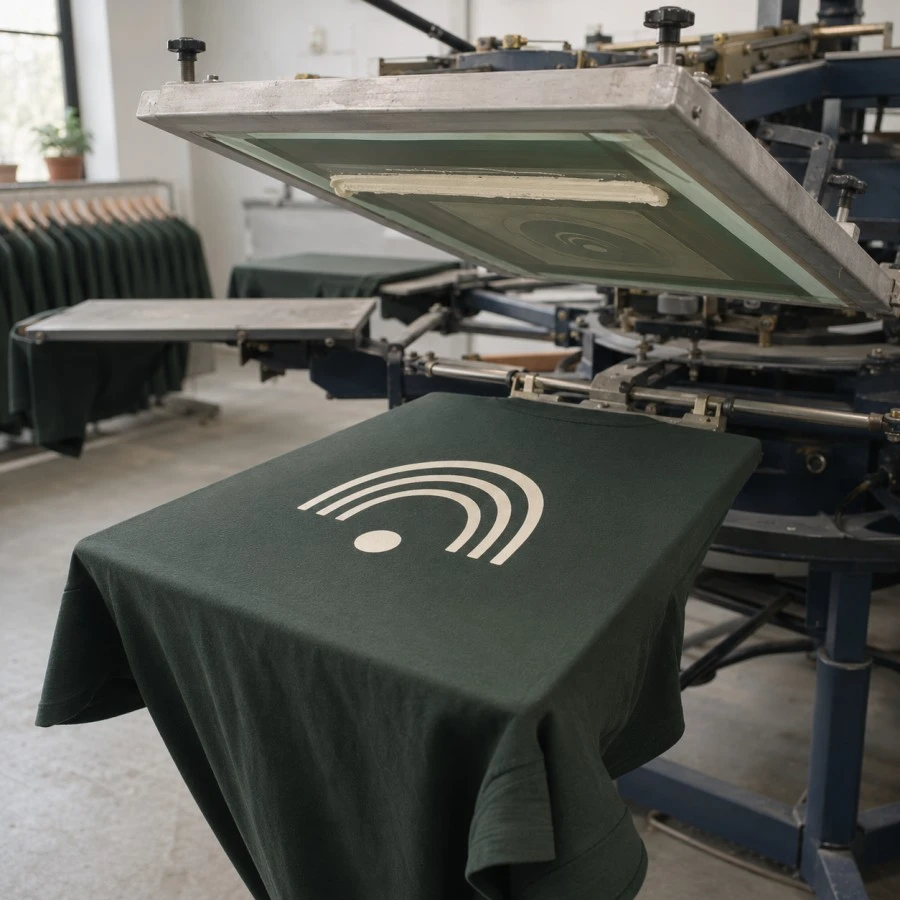
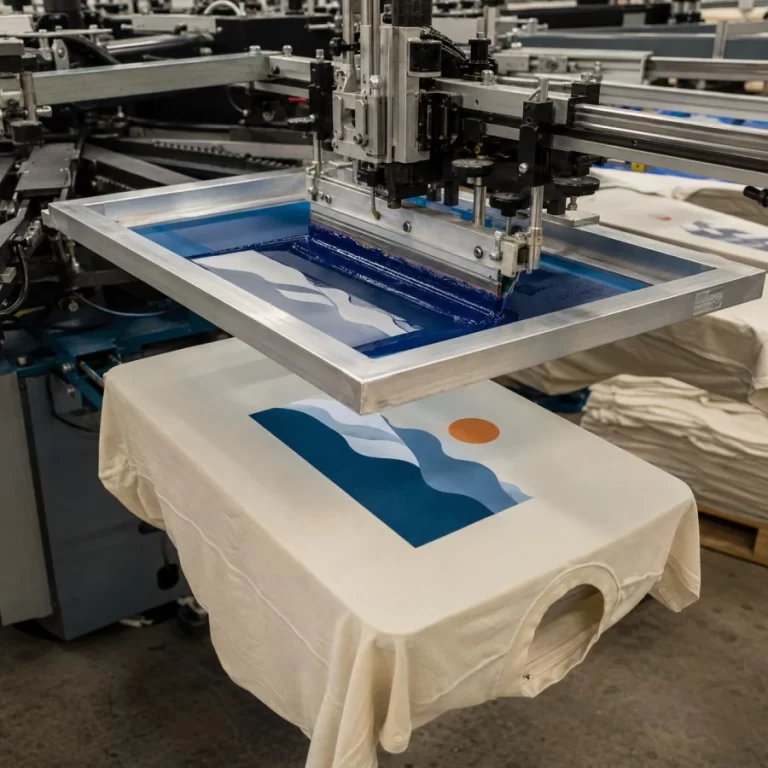
Screen printing pushes ink through a mesh stencil onto fabric, one screen per colour.
It is the oldest apparel decoration method still in daily commercial use, and it stays that way for one reason: nothing else lays down this much ink, this consistently, across this many garments.
We run silk screen printing from our East Vancouver facility for staff uniforms, team apparel, event merchandise and branded retail runs. Screens are made, printed and cured in house, so colour stays identical from the first shirt to the last.





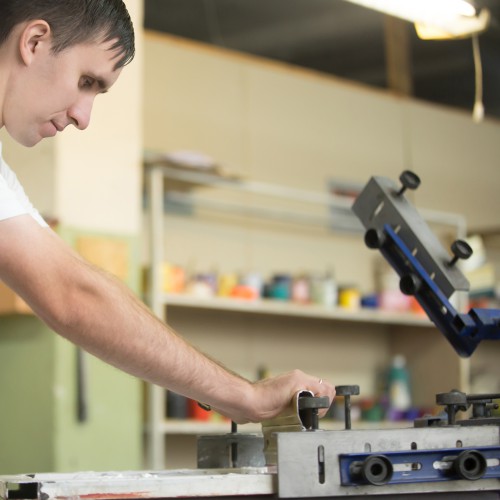
How Screen Printing Works
- Colour separation: artwork is split into one layer per ink colour.
- Screen exposure: each layer is burned onto a mesh screen coated in light-sensitive emulsion.
- Registration: screens are aligned on the press so every colour lands exactly where it should.
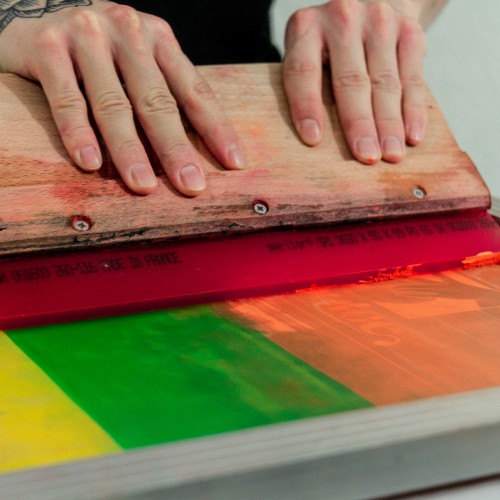
- Printing: a squeegee pushes ink through the open mesh onto the garment, one colour at a time.
- Curing: the garment passes through a dryer that brings the ink to full cure temperature.
Curing is the step that decides whether a print survives. Ink that has not reached full cure temperature looks perfect on the day and cracks after four washes. Every run through our dryer is temperature-checked before it is packed.
Plastisol vs Water-Based vs Discharge Ink
The type of ink affects how the finished print looks, feels and performs over time. We select the ink based on the garment material, colour, design and finish you want.
Plastisol Ink
Plastisol ink sits on top of the fabric, creating a bold, opaque and highly saturated print. It offers excellent durability and works on both light and dark garments. It is commonly used for company logos, uniforms, team apparel and promotional clothing.
Feel: Sits on top of the fabric
Best for: Light or dark garments and durable everyday printing
Result: Bold colours, strong opacity and excellent durability
Water Based Ink
Water based ink soaks into the fabric fibres instead of forming a heavy layer on the surface. This creates a soft, breathable print with very little noticeable texture. It is especially suitable for lightweight, 100% cotton garments.
Feel: Soft with almost no noticeable print layer
Best for: Light coloured, 100% cotton garments
Result: A smooth, vintage and naturally worn-in appearance
Discharge Ink
Discharge ink removes the existing dye from a dark cotton garment and replaces it with coloured pigment. Because the design becomes part of the fabric, it produces an exceptionally soft and breathable result.
Feel: Becomes part of the fabric
Best for: Compatible dark, 100% cotton garments
Result: A soft, high quality print without a heavy ink layer
Specialty Inks
Specialty inks create distinctive finishes such as puff, metallic, reflective, high-density and glow in the dark effects. Availability depends on the garment, artwork and desired result.
Feel: Raised, textured, reflective or decorative
Best for: Selected garments, retail apparel and merchandise
Result: A distinctive finish that makes the printed design a central feature of the product
Not sure which ink is right for your project? Tell us about the garment, artwork and finish you want, and we will recommend the most suitable option.
Colour Separations and Artwork Setup
How many colours can you print?
Each colour needs its own screen, its own pass and its own registration. Simple one and two colour logos are the most economical and the fastest to produce.
Multi colour designs are entirely possible, they simply carry more setup. If your artwork uses more colours than the design needs, we will tell you where two shades can be merged without anyone noticing.
Screen Printing on Dark Garments
Dark fabric absorbs colour, so a red printed straight onto black reads as brown.
The fix is an underbase: a white ink layer printed first, flashed dry, then the colours printed on top.
It adds a pass but it is what keeps a logo looking like the logo on a black hoodie.
How Halftones Reproduce Gradients
Screen printing lays flat colour, so gradients are reproduced with halftones, patterns of dots that read as a blend from normal viewing distance. It works well for shading and fades.
Photographic artwork with fine continuous tone is where screen printing reaches its limit, and we will say so before quoting rather than after printing.
Pantone Colour Matching for Brand Logos
We mix to Pantone references. Send your PMS codes with your artwork and colour stays consistent across this order and every reorder after it.
Without a reference we match to the closest standard ink, which is usually fine for internal apparel and not fine for a brand with published guidelines.
Artwork File Formats for Screen Printing
Vector (AI, EPS, SVG, vector PDF): ideal; separations come straight off the file
High-resolution PNG or PDF: workable when clean and at final print size
Avoid screenshots, social media exports and low-resolution JPGs: they soften edges and add setup work
Garments, Placements and Minimums
We screen print t-shirts, hoodies, crewnecks, sweatshirts, long sleeves, polos and tote bags. Cotton and cotton rich blends take screen ink best; we will flag any fabric where a different approach would serve you better.
Placements include left chest, full front, full back, sleeve, and multiple placements on one garment. The same design can run across mixed garment types in a single order (tees for the wider team, hoodies for the crew) with placement adjusted so it sits correctly on each.
Minimum order: No minimums. Screens are made per colour per design, so that setup is what makes screen printing the most economical method at volume and the wrong one for a handful of shirts.
Our press: automatic, with standard stock ink colours available plus Pantone mixing.
What your quote is based on
- Quantity, unit cost drops as setup is spread across more garments
- Number of ink colours, and whether an underbase is needed
- Print size and number of placements
- Garment type and fabric
Caring for Screen Printed Apparel
Pass these on with the order and the print will outlast the garment:
- Wash inside out in cold water on a gentle cycle
- Avoid bleach and fabric softener
- Tumble dry low or hang dry, high heat is harder on cured ink than washing is
- Iron inside out, never directly on the print
When Screen Printing Is Not the Right Fit
We would rather tell you before the order. Screen printing is the wrong choice for photographic artwork with continuous tone, for designs with a high colour count on a small run, and for one off or individually personalised pieces where per garment setup cannot be spread across a quantity. Stitched logos on caps and heavyweight outerwear are usually better served by embroidery, and full colour artwork on small runs by DTF.
If you are still deciding, our guide to t-shirt printing methods compares the options side by side.

- Terrific customer service -- I had a rush order and Firebird did a great job. When a girl needs Hollander and Rozanov hockey jerseys for a Heated-Rivalry-themed dance party, time is of the essence....
- We had an amazing experience working with Mohammed, Ashley, and the entire team. From start to finish, everyone was professional, responsive, and incredibly helpful.This was our very first business...
- Excellent experience with FireBird Prints! The custom tablecloth turned out beautifully with vibrant colors, crisp printing, and great material quality. Fast turnaround, professional service, and...
- Found the company strictly from its reviews and was a bit nervous since I completed the transaction online and payment was upfront. But price was good and so took a chance. I am so happy with the...
- We cannot say enough wonderful things about Firebird Prints!No matter how last-minute our requests are, the team at Firebird Prints always comes through for us. They consistently go above and...
Screen Printing FAQ
What is screen printing?
A method where ink is pushed through a mesh stencil onto fabric, using one screen per colour. Also called silk screen printing. It produces bold, opaque colour with high durability, and becomes more economical per garment as quantity rises because the setup is spread across the run.
Is there a minimum order for screen printing?
There is no minimums. Screens are produced per colour per design, so that fixed setup is what makes screen printing the most cost effective method at volume and impractical for very small quantities.
Is screen printed apparel durable?
Yes, it is the most durable apparel decoration method when cured correctly. The variable is curing: ink that has not reached full temperature will crack early regardless of how good it looked leaving the shop. Wash inside out in cold water and dry on low to get the full life out of it.
Can you screen print on dark shirts?
Yes. Dark garments take a white underbase printed first and flashed dry, with the colours printed on top. This keeps colours accurate rather than letting the fabric dull them. Discharge ink is an alternative on 100% cotton darks, giving a much softer finish.
What is the difference between plastisol and water based ink?
Plastisol sits on top of the fabric and gives bold, opaque, highly durable colour on any garment. Water based ink soaks into the fibres for a soft, vintage finish, and works best on light 100% cotton. Discharge is a third option for dark cotton where a soft hand matters most.
Can you match my brand colours?
Yes, using Pantone references. Send your PMS codes with your artwork and colour stays consistent across this order and future reorders.
How many colours can be printed in one design?
Multiple colours are possible, each requiring its own screen and print pass. Fewer colours mean less setup and faster production. If a design uses more colours than it needs, we will suggest where shades can be combined without changing how it looks.
What artwork format should I send?
Vector files (AI, EPS, SVG or vector PDF) are ideal because colour separations come directly off the file. A clean high resolution PNG or PDF at final print size also works. Avoid screenshots and compressed images, which soften edges and require rebuilding.
Fill out this quick form. We will get back shortly!
Order as many as you want
Rush Production Available
Get Your 20% Off
Bigger Orders, Bigger Savings
info@firebirdprints.com
+1 778 368 0288
How to Order Screen Printed Apparel
Production runs from East Vancouver, with local pickup and delivery across the region.
We print for businesses, schools, teams and event organisers in Vancouver, Burnaby, Richmond, Surrey, Delta, Langley, Maple Ridge, Pitt Meadows, New Westminster, Port Coquitlam, Coquitlam, White Rock, Abbotsford, North Vancouver and West Vancouver.