
Custom Coasters
Made to Be Seen
- 40pt to 80pt
Thickness matched to how often it gets reused
- Round, Square or Die Cut
Standard shapes or cut to your outline
- Both Sides Printed
Two surfaces, two messages, one order
- Volume Pricing
Cost per coaster drops sharply as counts rise








Custom Printed Coasters for Bars, Cafes and Events
A coaster is the only branded item that sits directly in front of someone for the entire time they are drinking. Nobody puts it away, nobody has to be persuaded to use it, and it stays in view through a whole conversation. That is a longer look than almost anything else you can print.
Firebird Prints produces coasters for hospitality venues, breweries, offices and events across Canada. Two things decide whether they work: the board thickness and how the design handles a wet glass being put down on it.
What Pulpboard Is and Why It Absorbs
Pulpboard, also called coaster board, is a thick absorbent paperboard made specifically for drink coasters. It is not the same as card stock, and the difference is structural.
Card stock is compressed and sealed, so condensation sits on the surface and eventually runs onto the table. Pulpboard is loosely bonded wood fibre, so it draws moisture in and holds it. That is the whole function. A coaster that does not absorb is just a printed square that slides around under a glass.
It is also a paper product, which means it is recyclable, and for most venues it is the material customers expect to see under a pint.
40pt, 60pt, or 80pt
Thickness is measured in points, where one point is one thousandth of an inch. It is the single most useful number when comparing coaster quotes, because two coasters that look identical in a photo can feel completely different in the hand.
40pt is roughly a millimetre, about the thickness of a credit card. Light, the most economical, and suited to high volume single event use where you are handing out thousands and not expecting them back.
60pt is roughly one and a half millimetres. The middle option and the most common choice for bars and cafes, because it holds up through a shift without feeling flimsy.
80pt is roughly two millimetres and noticeably substantial. Worth stepping up to when coasters stay on the table for repeat use, or when you want the coaster itself to signal that the venue is not cutting corners.
The rule that works: order by how many times each coaster will be used, not by how many you need.
Round, Square, or Cut to Your Shape
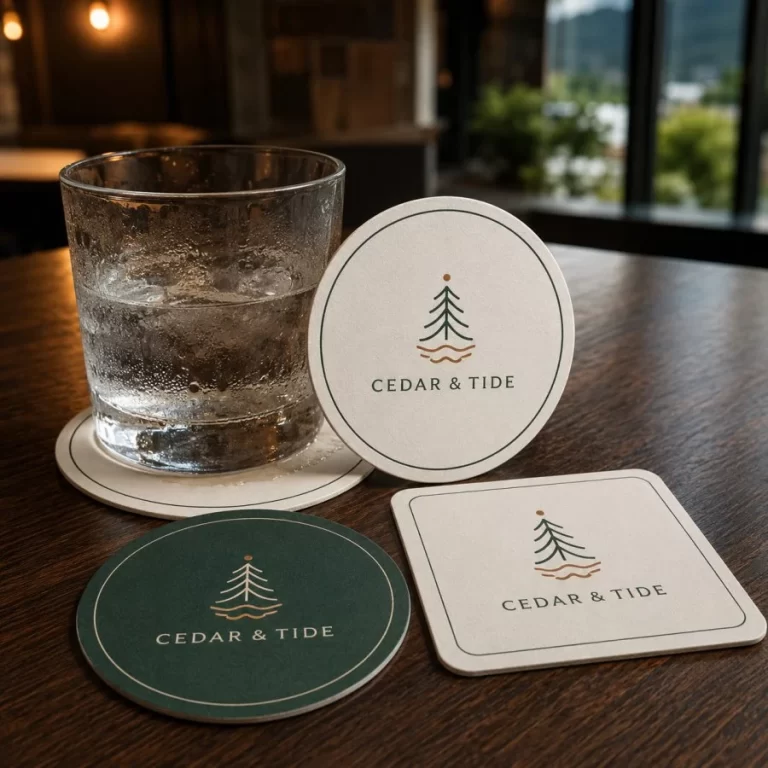
Standard sizes are 3.5 inch and 4 inch, in round or square with rounded corners. Those two cover most orders and they are what a venue’s existing coaster holders are built for.
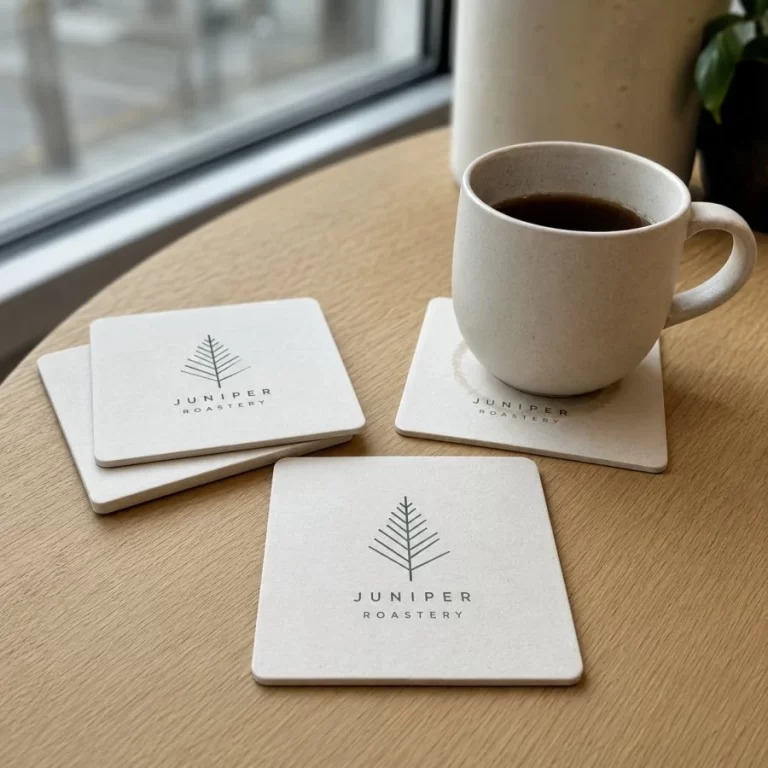
Round reads as traditional bar and pub. Square gives you noticeably more usable print area for the same footprint, which matters if your design has any text in it.
Custom die cut shapes are also possible, cut to the outline of a logo, a bottle silhouette, or a product shape. This costs more because it needs its own cutting die, so it makes sense for a launch or a signature venue piece rather than for everyday stock.
Both Sides Are Worth Using
Coasters flip constantly. A customer picks one up, turns it over, puts it down the other way. That means the reverse is seen almost as often as the front, and printing one side only wastes half the item.
The pattern that works best in hospitality is a clean brand side and a working side. Logo on the front, and on the back a seasonal drink, a social handle, a QR code to the menu, or an event listing.
Because the reverse changes more often than the brand does, some venues keep the front constant across reorders and update the back each season.
Designing for a Wet Glass
This is where coaster artwork differs from everything else you print, and it is the part most people find out about after the run.
A glass covers the middle. Anything you put in the centre of a coaster spends most of its life hidden, which means centre-weighted logos are working only when the coaster is empty. Designs that place the important content toward the outer ring stay readable while the coaster is actually in use.
Absorbency also affects the print itself. Pulpboard draws ink in slightly, so hairline strokes and small text soften more than they would on a coated stock. Keep type reasonably sized and strokes reasonably thick, and check anything under about 8 point before committing.
Full bleed artwork needs extension past the trim, and important elements need to sit inside a safe margin, since cutting carries a small tolerance. You receive a digital proof at actual size before anything runs.
Where Branded Coasters Get Used
Bars, pubs and breweries. The core use case. Coasters are consumable here, so venues reorder on a schedule, and a good design frequently leaves in a customer’s pocket.
Cafes and restaurants. Less about spills and more about the table feeling considered. Often paired with a seasonal message on the reverse.
Tasting rooms and distilleries. Where the coaster carries product information, tasting notes, or a QR code to a shop.
Corporate offices and meeting rooms. Quiet branding in client facing spaces. Lower volume, and usually a heavier board because they stay in use rather than being replaced.
Weddings and private events. A date, a monogram, or a drink list. Frequently taken home, which is why heavier board is worth it for a one day event.
Kits and gift boxes. Flat, light, and easy to include, which is why they appear in custom swag boxes alongside heavier items.
Coasters sit alongside the rest of our promotional products and are commonly ordered with matching table items for hospitality venues.
Ordering the Right Quantity
Coaster board carries a printing setup, so cost per unit drops considerably as counts rise and then levels off. Small runs are practical, but the price per coaster is noticeably higher.
For a venue, the useful way to estimate is by service rather than by guesswork. Work from your average covers or pours per week, decide roughly how many coasters each drink consumes, and multiply out to however many weeks you want to hold stock for. Most venues land on a larger single order rather than repeated small ones.
Coasters store well flat and in a dry place, and your artwork stays on file so a reorder matches the first batch rather than arriving slightly different.

- Terrific customer service -- I had a rush order and Firebird did a great job. When a girl needs Hollander and Rozanov hockey jerseys for a Heated-Rivalry-themed dance party, time is of the essence....
- We had an amazing experience working with Mohammed, Ashley, and the entire team. From start to finish, everyone was professional, responsive, and incredibly helpful.This was our very first business...
- Excellent experience with FireBird Prints! The custom tablecloth turned out beautifully with vibrant colors, crisp printing, and great material quality. Fast turnaround, professional service, and...
- Found the company strictly from its reviews and was a bit nervous since I completed the transaction online and payment was upfront. But price was good and so took a chance. I am so happy with the...
- We cannot say enough wonderful things about Firebird Prints!No matter how last-minute our requests are, the team at Firebird Prints always comes through for us. They consistently go above and...
Custom Coasters FAQ
What thickness should I order?
40pt for high volume single use at events, 60pt for everyday bar and cafe service, 80pt where coasters stay on the table for repeat use. Thickness is measured in points, one point being a thousandth of an inch, and it is the number worth comparing between quotes.
What is pulpboard and why is it used?
Pulpboard is a thick absorbent paperboard made for drink coasters. Unlike card stock, which seals moisture on the surface, pulpboard draws condensation in and holds it. That absorbency is the entire point of a coaster.
What sizes and shapes are available?
Standard sizes are 3.5 inch and 4 inch in round or square with rounded corners. Square gives more usable print area for the same footprint. Custom die cut shapes are possible, but need their own cutting die, so they suit launches rather than everyday stock.
Can coasters be printed on both sides?
Yes, and it is worth doing. Coasters get flipped constantly, so the reverse is seen nearly as often as the front. Most venues put the logo on one side and something changeable on the other, such as a seasonal drink or a QR code.
Where should the logo sit on the design?
Away from the dead centre. A glass covers the middle for most of the coaster’s working life, so content placed toward the outer area stays visible while the coaster is in use. Centre-weighted designs only read when the coaster is empty.
Are printed coasters reusable?
Pulpboard coasters handle repeated use, and heavier board holds up longer. If one gets soaked, lay it flat to dry before using it again. Lighter board is better treated as single event use.
What file should I send?
Vector files such as AI, EPS, SVG or PDF give the cleanest result. Extend full bleed artwork past the trim and keep important elements inside a safe margin. Because pulpboard absorbs ink, thin strokes and small text soften slightly, so check anything hairline before production.
Fill out this quick form. We will get back shortly!
Order as many as you want
Rush Production Available
Get Your 20% Off
Bigger Orders, Bigger Savings
info@firebirdprints.com
+1 778 368 0288
Customised Coasters That Stay on the Table
A customised coaster is not flashy marketing. It is subtle, functional branding that works quietly in the background.
At Firebird Prints, we help Vancouver businesses create coaster board products that feel premium, last longer, and represent their brand properly.
Contact us today to get started with customised coaster printing in Vancouver.