DTF Printing in Vancouver
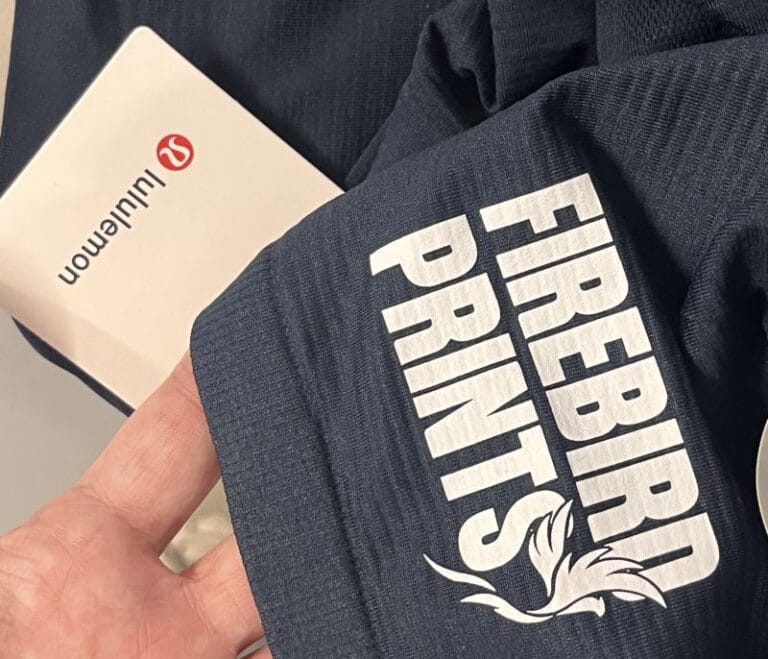
Firebird Prints runs direct to film printing from our Vancouver facility, printing and pressing full colour designs onto t-shirts, hoodies, uniforms, tote bags and event apparel. You send artwork and garments (or let us supply the blanks) and you get back finished, wearable product.
DTF is the method we reach for when a design has more colour than screen printing can handle economically, when the fabric is polyester or a blend that direct to garment struggles with, or when the run is too small to justify screens. No screens, no setup fees, no minimum order.
- No minimums and no setup fees: one shirt or one thousand
- Any fabric colour: a white ink base means black garments print as cleanly as white ones
- Any common fabric: cotton, polyester, blends, fleece, canvas and more
- Full-colour artwork: gradients, photographs, fine type and complex logos
- Printed and pressed in Vancouver: no cross border shipping, no customs, no duties




What is DTF Printing?
DTF stands for direct to film. The design is printed onto a PET carrier film with CMYK inks, backed with a layer of white ink, coated in hot melt adhesive powder, cured, then heat pressed onto the garment before the film is peeled away. Because the ink bonds to an adhesive layer instead of soaking into the fabric fibres, DTF reproduces full colour on any fabric type and any fabric colour.
That single structural difference is what separates DTF from every other apparel method. Screen printing needs a separate screen per colour. Direct to garment needs cotton and a pre-treatment step. Vinyl needs weeding and cannot do gradients. DTF has none of those constraints.
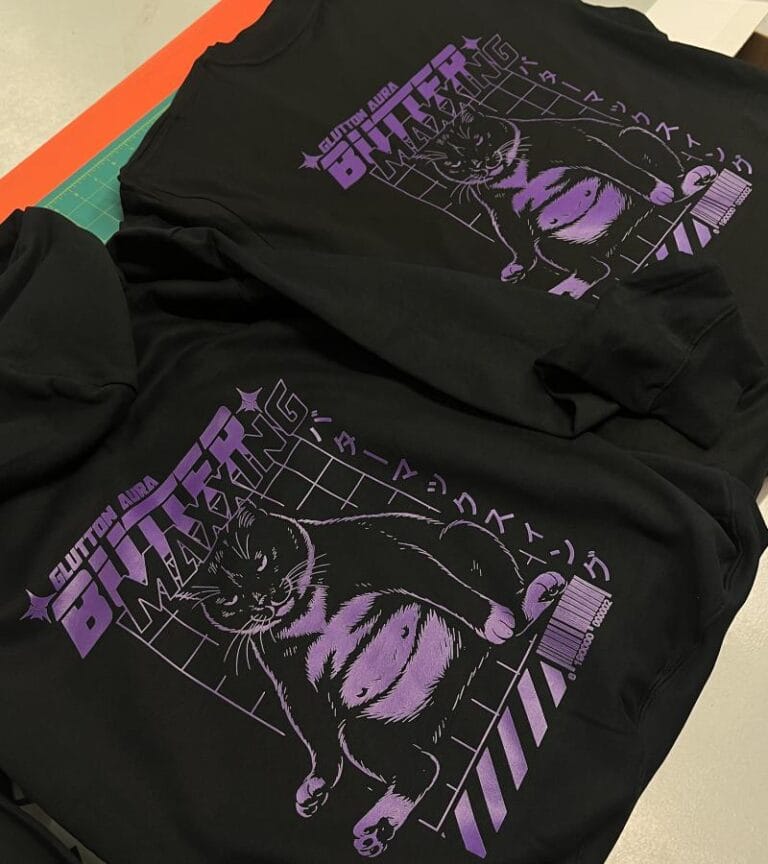
DTF Printing on Cotton, Polyester, Blends and Dark Garments
Fabric is one of the first things we consider because it affects adhesion, flexibility, colour accuracy and the required heat press settings. Here is how DTF printing performs across the materials we work with most often.
100% Cotton
DTF result: Excellent
DTF produces sharp details, vibrant colours and a soft, flexible finish on 100% cotton. It does not require fabric pre-treatment and is a strong alternative to DTG printing for custom cotton garments.
Polyester
DTF result: Excellent
Polyester is one of the strongest applications for DTF printing. The transfer adheres well and produces clean, vibrant results. Because some polyester fabrics can react differently to heat or experience dye migration, we adjust the press settings and test the material when necessary.
Cotton-Polyester Blends and Tri-Blends
DTF result: Excellent
DTF delivers consistent results across cotton-polyester blends and tri-blend garments. Unlike DTG printing, which can vary depending on the percentage of cotton in the fabric, DTF maintains strong colour and detail across a wider range of blended materials.
Performance and Athletic Fabrics
DTF result: Very good
DTF prints cleanly on many moisture wicking, stretch and performance fabrics. The finished transfer remains flexible and moves with the garment, making it suitable for sportswear, team apparel and activewear.
Fleece and Sweatshirt Fabrics
DTF result: Very good
DTF is well suited to hoodies, crewneck sweatshirts and other fleece garments. Fabrics with a heavier pile may require adjusted temperature, pressure or pressing time to achieve proper adhesion and a clean finish.
Canvas and Tote Bag Fabrics
DTF result: Very good
DTF provides strong adhesion and vibrant results on cotton canvas and many jute-blend tote bags. It works particularly well for detailed logos, colourful artwork and promotional designs.
Denim
DTF result: Good
DTF works well on denim jackets, jeans and other denim products. Because denim has a heavier and more textured weave, firmer press pressure may be needed to secure the transfer evenly.
Nylon
DTF result: Case by case
Some nylon fabrics can be printed successfully with DTF, but results depend on the material’s coating and sensitivity to heat. We test the fabric before confirming a larger production run.
Waterproof and Heavily Coated Fabrics
DTF result: Not recommended
Waterproof coatings and other heavy surface treatments can prevent the transfer from bonding properly. For these materials, we may recommend embroidery or a custom patch instead.
DTF Printing vs Screen Printing vs DTG vs Vinyl
Each decoration method serves a different purpose. The best choice depends on your order quantity, fabric, artwork, colour requirements and preferred finish.
DTF Printing
DTF is one of the most versatile options for custom apparel. It works for orders ranging from a single item to bulk production, with no setup or per screen charges.
It supports unlimited colours, photographic artwork, gradients and very fine details. DTF performs exceptionally well on cotton, polyester, blended fabrics and dark garments, with no garment pre-treatment required. The final print feels soft, flexible and comfortable while maintaining strong colour and detail.
Best for: Small or large orders, full colour designs, detailed artwork, polyester, blends and dark garments.
Screen Printing
Screen printing is most cost effective for large production runs, especially when the artwork uses a limited number of solid colours. Each colour normally requires a separate screen, so setup costs increase as more colours are added.
It performs exceptionally well on cotton and produces good results on polyester and blended garments when the proper inks and techniques are used. Dark garments require an underbase to keep the colours bright and accurate. The final feel can vary depending on the ink type, number of colours and amount of ink used.
Best for: Large volume orders with simple artwork and a limited colour palette.
DTG Printing
DTG is generally best suited to small and medium sized orders. It supports unlimited colours, photographic images, gradients and fine details without requiring screen setup charges.
It produces excellent results on cotton and offers the softest finish of the four methods. However, its performance is weaker on polyester and blended fabrics. Dark garments also require pre treatment before printing, which adds an extra step to the production process.
Best for: Detailed, full colour artwork printed primarily on cotton garments.
Vinyl Printing
Heat-transfer vinyl, commonly called HTV, is best suited to very small orders with simple designs. It works with solid colours but is not ideal for photographic images, gradients or extremely fine details.
Vinyl produces good results on cotton, polyester, blends and dark garments, with no setup charges required. However, it creates the thickest and least breathable finish compared with DTF, screen printing and DTG.
Best for: Names, numbers, simple lettering and small orders with solid colour artwork.
- Choose DTF when the artwork is full colour, the fabric is not pure cotton, the garment is dark, or the run is small.
- Choose screen printing when you are running high volume with one or two solid colours and want the lowest unit cost.
- Choose DTG when you want the absolute softest hand on 100% cotton and the design is photographic.
- Choose vinyl when you need names and numbers on team kit and nothing more complex.
When DTF is not the right method
We would rather tell you this before the order than after:
- Very large single-colour runs: screen printing will be more economical per piece.
- Ultra-thin hand feel on 100% cotton: DTG sits lighter on the fabric.
- Waterproof or heavily coated fabric: surface coatings resist the adhesive layer.
- Heat-sensitive garments: some technical and specialty fabrics will not tolerate press temperatures.
- Very large solid blocks of ink: a full front solid coverage design will feel heavier than the same design broken up with detail.
If your project falls into one of those, we will say so and quote the method that suits it.
Who DTF Printing Suits Best
DTF for Small Businesses and Startups
Staff shirts, branded uniforms, seasonal campaigns and promotional apparel, without committing to a screen-printing minimum before you know what sells.
DTF for Apparel Brands and Merch Drops
Limited runs, test designs and multiple artworks in one order. No setup charge per design means a ten design drop costs the same to set up as a one design drop.
DTF for Event and Festival Crew Shirts
Crew shirts, volunteer tees, sponsor apparel and merch tables. Vancouver’s event calendar moves fast and DTF absorbs late artwork changes better than screen printing.
DTF for School and Team Apparel
Club hoodies, student merch, training shirts and team apparel, including full colour crests and multi colour school logos that would be expensive to screen print. See school and team apparel printing.
DTF Transfers for Print Shops and Resellers
If you press garments in house and only need the film, order ready-to-press DTF transfers instead. For multiple designs nested on a single sheet, DTF gang sheet printing lowers your cost per transfer.
What We Print with DTF
DTF handles the majority of apparel decoration we take on:
- Custom t-shirts: cotton, polyester and blends, light and dark
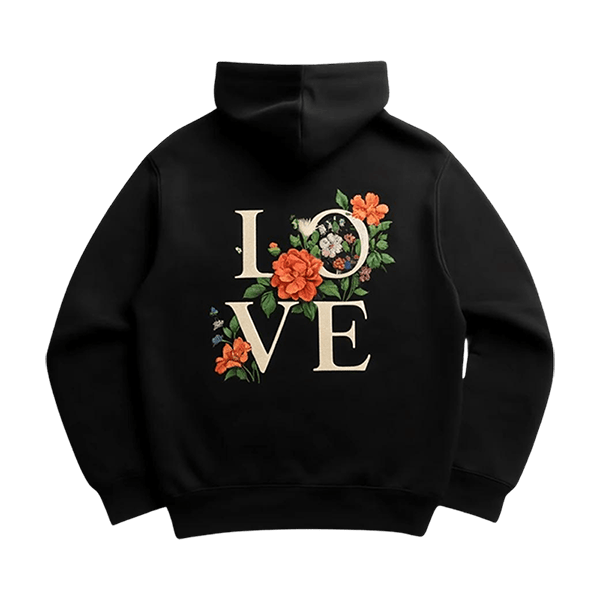
- Hoodies and sweatshirts : front, back, sleeve and hood placements
- Activewear and performance apparel: where DTG cannot compete
- Uniforms, workwear and staff shirts: durable logo application for daily wear
- Tote bags and fabric accessories
- Polo shirts and tank tops
- Event crew shirts, volunteer tees and sponsor apparel
Artwork Requirements for DTF Printing
Most print problems are file problems, and they are all fixable before production if we see the file early.
Best File Formats for DTF Printing
- Vector (AI, EPS, SVG, vector PDF): best for logos, type and flat graphics; scales to any print size with no loss
- PNG with transparent background: for illustrations and photographic artwork
- PDF: acceptable when the artwork is embedded at full resolution
Resolution and Transparent Backgrounds
- 300 dpi at final print size, not at thumbnail size
- Transparent background where the garment should show through
- Clean, hard edges, soft or feathered edges can leave a visible film halo
- Pantone references supplied where brand colour accuracy matters
- Minimum practical type size around 6pt; finer than that can close up in the powder stage
Artwork Problems That Delay a DTF Order
- Screenshots and images saved from social media or a website
- Low-resolution JPGs scaled up to print size
- White backgrounds left on a design meant to sit on a coloured garment
- Artwork built at a small size and enlarged rather than rebuilt
Send the file you have and we will review it before quoting. If it needs rebuilding we will tell you what is required rather than printing something that will disappoint you.
Local Pickup & Service Area
Production runs from our East Vancouver facility on Victoria Drive. Nothing crosses a border, which means no customs brokerage, no duties and no unpredictable cross border delays, a real difference when a deadline is fixed.We serve businesses, schools, teams and event organisers across Metro Vancouver:
- Vancouver
- Richmond
- North Vancouver
- West Vancouver
- Burnaby
- Surrey
- Delta
- Langley
- Coquitlam
- Port Coquitlam
- Pitt Meadows
- Maple Ridge
Local pickup is available, and rush production can be arranged for time sensitive orders. If you are working to a fixed event date, tell us the date when you request a quote and we will confirm what is achievable before you commit.
Frequently Asked Questions
What is DTF printing?
DTF stands for direct to film. The design is printed onto a PET carrier film with CMYK inks, backed with a white ink layer, coated in hot melt adhesive powder, cured, then heat pressed onto the garment before the film is peeled away. Because the ink sits on an adhesive layer rather than soaking into the fibres, DTF reproduces full colour on any fabric colour.
Does DTF printing work on polyester?
Yes, and it is one of the strongest reasons to choose DTF. Polyester and performance fabrics are difficult for direct to garment printing, which relies on water based ink absorbing into cotton fibres. DTF bonds an adhesive layer to the surface instead, so polyester, poly blends and technical sportswear all print cleanly.
Can you print DTF on dark garments?
Yes. Every DTF transfer is printed with a dedicated white ink layer behind the colours, which blocks the garment colour from showing through. Colours stay accurate on black, navy and other dark fabrics with no pre-treatment step, which is the main advantage over direct to garment printing on darks.
Does DTF printing work on cotton?
Yes. DTF prints cleanly on 100% cotton, cotton-poly blends and tri-blends. On cotton it competes directly with direct to garment printing, and the practical difference is that DTF holds finer detail on blends and needs no pre-treatment.
Is DTF printing durable in the wash?
Yes, when applied with correct temperature, pressure and dwell time. A correctly pressed DTF print flexes with the fabric rather than sitting rigid on top of it, which is what prevents cracking. Wash inside out in cold water and avoid ironing directly on the print to get the longest life.
What is the minimum order for DTF printing in Vancouver?
There is no minimum. DTF has no screens and no setup charges, so a single shirt is viable in a way it is not with screen printing. That makes it practical for sample runs, one off pieces and test designs as well as full production orders.
What file should I send for DTF printing?
A vector file (AI, EPS, SVG or vector PDF) is best for logos and type. For illustrations and photographic artwork, send a PNG with a transparent background at 300 dpi at final print size. Avoid screenshots, social media exports and images pulled from a website.
What is the difference between DTF printing and DTF transfers?
DTF printing is the full service: we print the transfer and press it onto your garments, and you receive finished apparel. DTF transfers are film only, supplied ready to press so you can apply them yourself with your own heat press. Print shops and brands that press in house order transfers; businesses that want finished garments order the printing service.
When is DTF not the right printing method?
Very large single colour runs are usually more economical with screen printing. Designs needing an ultra-thin hand feel on 100% cotton may suit direct to garment better. Heavily textured or waterproof coated fabrics can resist adhesion, and heat sensitive garments may not tolerate press temperatures. We will tell you when another method is the better fit.
Fill out this quick form. We will get back shortly!
Order as many as you want
Rush Production Available
Get Your 20% Off
Bigger Orders, Bigger Savings
info@firebirdprints.com
+1 778 368 0288
Request a DTF Printing Quote
Send us these five things and we will come back with a quote:
- Your artwork, or a rough version of it
- The garment type, t-shirt, hoodie, tote, uniform
- Print size and placement
- Quantity
- Your deadline, if you have one
If you are unsure whether DTF is the right method for your project, send the details anyway. We will tell you if screen printing, embroidery or DTG would serve you better.