Every company has a drawer. It is in the kitchen or under someone’s desk, and it holds the branded water bottle that leaks, the pen that stopped writing, and three t-shirts in a size nobody asked for. Somebody paid for all of it.
The gap between swag that gets kept and swag that gets binned is not really about budget. Plenty of expensive items go in the drawer and plenty of cheap ones survive for years. The difference is whether the item passes a test the recipient applies without thinking about it.
Why Most Company Swag Ends Up in a Drawer
Internal merchandise fails for reasons that are predictable enough to design around.
It duplicates something the person already owns and prefers. It is a size or colour they would never choose. The logo is so large the item reads as advertising rather than a gift. Or it simply does not do its job well, which is the fastest route to the bin, because a bottle that leaks is worse than no bottle.
Notice that none of those are budget problems. They are selection problems, and they are fixable before you order anything.
Would They Buy It Themselves?
This is the only filter that consistently works. Strip the logo off the item, put it on a shelf at a reasonable price, and ask whether the person receiving it would pick it up.
If the answer is yes, the branding is a bonus and the item gets used. If the answer is no, no amount of logo placement will save it. People do not keep things because they are free. They keep things because the thing is good.
Applying this filter usually means buying fewer items at a higher quality per item, which is a conversation worth having with whoever holds the budget before the order goes in.
Everyday Items Given to Everyone
The baseline tier. These go out at all-hands meetings, sit in the supply cupboard, and get handed to anyone who asks. Notebooks, pens, stickers, reusable bags, and mugs live here.
The bar is lower but not absent. A pen that writes badly still gets thrown away, and it still cost money. Buy the version that works rather than the cheapest version that exists, because the marginal cost is small and the difference in survival rate is not.
The One Good Item Per Person
This is where most of the value sits, and where most companies underinvest. One properly chosen item per employee per year beats four mediocre ones.
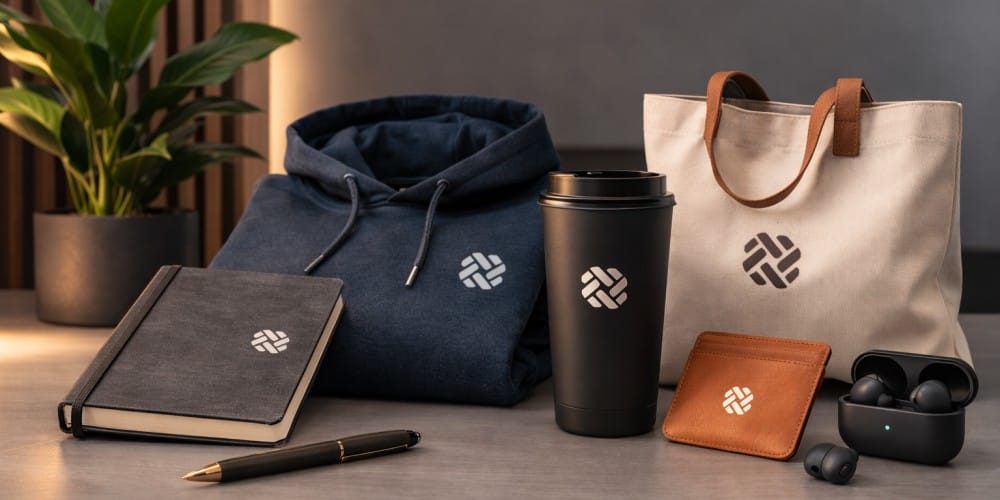
Insulated drinkware works because it gets used every single day and it is visible to everyone in the room. A heavy hoodie works because comfort keeps it in rotation for years. A properly made tote bag works because it goes everywhere the person goes.
What these share is daily contact. An item that touches someone’s routine every morning generates more impressions and more goodwill than anything sitting on a shelf.
Milestone and Recognition Gifts
A different job entirely. Work anniversaries, project completions, and promotions call for something that reads as a marker rather than as stock.
The logo should be smaller here, or absent. Engraving instead of printing. Something with a name or a date on it. The point of a recognition gift is the recognition, and heavy branding undercuts it by making the gesture look like a marketing exercise.
Logo Size Is the Difference Between Gift and Ad
The single most common mistake in internal merchandise is treating an employee item like a billboard.
A chest-width logo across a hoodie is a uniform. A small mark on the left chest or the sleeve is a piece of clothing that happens to be branded, and people wear it on weekends. The second version generates far more actual brand exposure, because it leaves the building.
The same logic applies everywhere. A tumbler with a wrap-around logo stays at the desk. A tumbler with a discreet mark goes to the gym.
Colours People Will Actually Wear
Brand colours belong on the logo, not necessarily on the garment. A company whose brand is bright orange will get more wear out of black, charcoal, or oatmeal apparel carrying an orange mark than out of an orange hoodie.
Neutrals also solve a quieter problem. They work across a much wider range of people, skin tones, and personal styles, which matters when you are ordering one thing for a whole team.
If you want the brand colour to lead, put it on the items people do not wear. Notebooks, bags, and drinkware can carry a strong colour without asking anyone to build an outfit around it.
Matching Swag to How Your Team Works
Remote and Hybrid Teams
These people are in their own homes, so the item competes directly with things they chose themselves. That raises the quality bar. Desk items, good drinkware, and comfortable outerwear work. Anything office-specific does not.
Office Based Teams
Items that live at a desk get used constantly and stay visible to colleagues and visitors. Drinkware, notebooks, and bags all perform well here.
Field and Outdoor Teams
Function decides everything. Weather-appropriate outerwear, headwear, and anything that survives being thrown in a truck. Decoration needs to survive too, which usually means embroidery over print.
Client Facing Teams
The item is seen by people outside the company, so it has to look professional rather than casual. This is where a tidier, more restrained treatment earns its place.
Letting People Choose Beats Guessing
Guessing sizes and preferences for a whole team guarantees waste. A share of every order goes to someone who will not use it, and you paid for that share.
Offering a choice fixes most of it. That can be as simple as two colourways and a proper size run, or as structured as a selection form that people fill in before anything is produced. Either way the item lands with someone who wanted it.
This costs a little more coordination and saves a lot of unused stock. If you are running a swag programme at any scale, it is the highest return change you can make.
Ideas That Sound Good and Rarely Land
Some items appear on every list and disappoint in practice.
Cheap tech accessories date fast and are frequently worse than what the person already carries. Novelty desk objects amuse for a day and clutter forever. Items that need assembly or a manual will not get either. Anything sized to a trend has a short shelf life, and anything with a year printed on it is dead in January.
None of these are bad ideas in principle. They are just items where the failure rate is high enough that the money is better spent elsewhere.
Turning Ideas Into an Actual Programme
Choosing good items is half the work. The other half is deciding when they go out, to whom, and in what form, so the programme runs on a schedule instead of a scramble.
The most common structure is a kit at the start, then individual items at intervals. For the first part of that, see our guide on how to build a corporate swag kit for new employees. For the full range of items available, browse promotional products or the corporate merch collection.